
Top-rated independent heating and cooling across Tampa Bay and Florida's Gulf Coast
Puddles by the Furnace
You walk past the air handler or furnace closet and there is a puddle on the slab. Maybe a damp ring, maybe water creeping toward the carpet. Water around a heating and cooling system almost always comes from condensate that is not draining, and the fix is usually small if you catch it early. Here is where that water comes from and what to do next.
Call (888) 365-6280- A real person answers
- Open 7 days
- Written quote before work starts
Taking calls until 5:00 PM ET
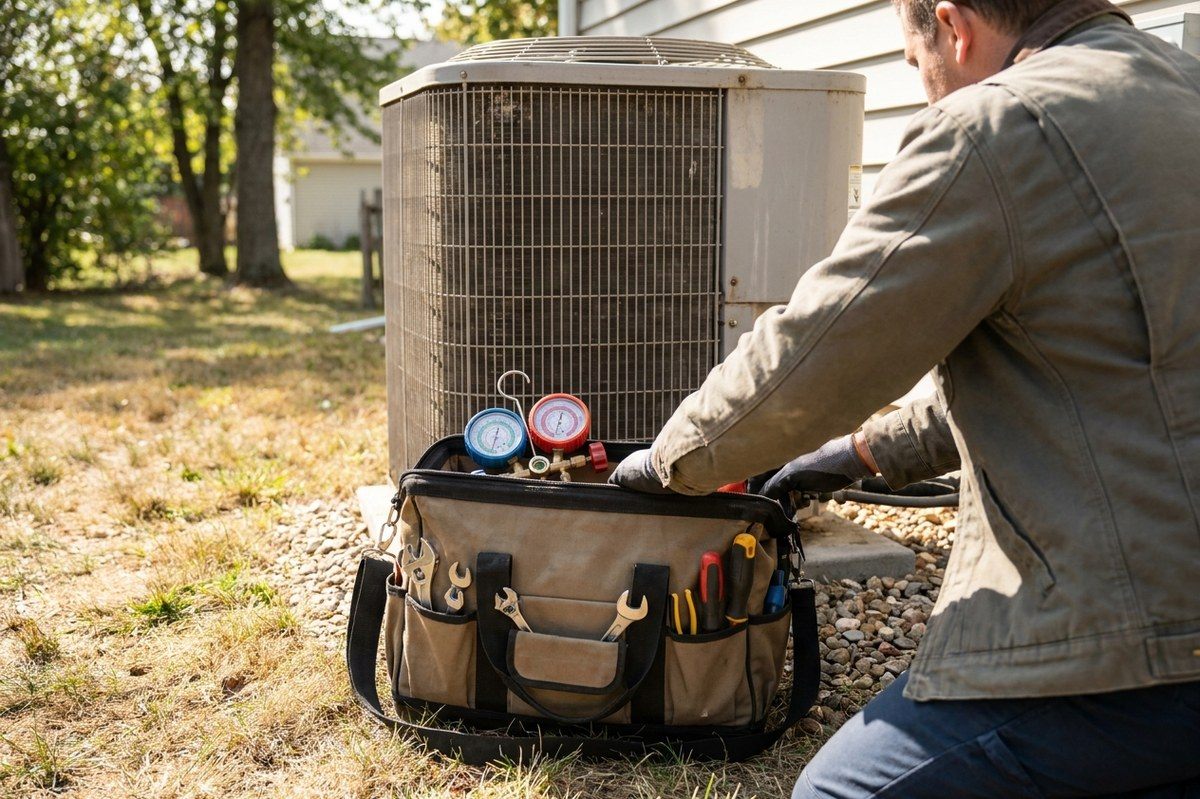
From the technicians at Pinellas Air & Heat
What the puddle is actually telling you
Water on the floor near your furnace or air handler is nearly always condensate, the moisture your system pulls out of the air. In our climate a system can pull gallons a day out of humid indoor air, and all of it has to leave through a drain line. When that path is blocked, slow, or broken, the water backs up in the drain pan and spills over the edge. Less often the water is a leak from something above, a water heater sharing the closet, or a roof issue. Either way, the water is a symptom of drainage, not of the blower or the burners. Shut the system off at the thermostat and call for air conditioning repair before the drywall soaks.
Cause one: a clogged condensate drain (cheapest and most common)
The drain line is a small PVC pipe running from the drain pan to a sink drain, a condensate pump, or outside. Dust, algae and the fine slime that grows in warm standing water build up inside it, and near the coast that gunk forms fast. Once the line plugs, the pan fills and water finds the floor. Some systems have a float switch that shuts things down before you see water, so if your cooling quit and there is moisture in the cabinet, suspect the drain. A technician clears the line, flushes it, checks the trap and vent, and confirms the switch works. This is the least expensive outcome and the one we find most often.
Cause two: a rusted or cracked drain pan, cause three: the coil itself
Drain pans sit under the evaporator coil and take constant moisture. Older galvanized pans rust through at the seams, and plastic secondary pans crack when they age or get stepped on during past work. Water then drips straight to the floor even with a clear line. The coil can also be the problem. A dirty, matted coil sheds water off the fins in the wrong direction, past the pan lip, and a frozen coil melts into a flood once the system cycles off. Frost usually points to airflow starvation from a loaded filter or a closed-off return, or to a refrigerant problem that needs gauges and a technician. Coil and refrigerant work is not homeowner territory.
Cause four: a high-efficiency furnace or a failed condensate pump
If you have a high-efficiency gas furnace, it makes its own condensate during heating, and that acidic water runs through a collector box, a trap and tubing. Those traps clog, the tubing kinks, and the water leaves at the cabinet. If the drain has nowhere to fall by gravity, a small condensate pump moves it. Pumps fail with a stuck float, a burned motor, or a check valve full of sludge, and then the reservoir simply overflows onto the slab. You may hear the pump buzzing without pumping. Neither the furnace trap nor the pump is a place to improvise, especially with gas involved. Note what you see and let us open it up.
What is safe for you to check, and what we do differently
You can safely turn the system off at the thermostat, change a loaded filter, confirm supply and return vents are open, check that the breaker has not tripped, and clear leaves or debris away from the outdoor unit. Mop the water and put a towel down so the puddle does not spread. That is the line. Do not open the burner compartment, touch refrigerant lines, or run a snake into a drain you cannot see. If you smell gas at any point, leave the building first, call 911 or your gas utility from outside, then call us. On arrival we clear and flush the drain, pressure-test the trap, inspect the pan and coil, verify the float switch, and check the pump and static pressure so it does not refill next week. We handle air conditioner repair and heating repair for homeowners across Florida and Georgia.
Puddles by the Furnace — straight answers
Can I keep running the AC with water on the floor?
We would not. Turn it off at the thermostat. Running it keeps making condensate that has nowhere to go, and standing water near electrical components and drywall gets expensive fast. Call for air conditioning repair the same day.
Why does this happen more in summer than winter?
Cooling pulls large amounts of moisture out of humid indoor air, so summer produces far more condensate than heating does. Any weakness in the drain shows up first during the hottest, most humid stretch of the year.
Will pouring bleach down the drain line fix it?
Sometimes it slows regrowth, but it does not clear an existing clog and it can damage metal pans and pump parts. A proper flush from the right access point, with the trap checked, is the durable fix.
How it works
- Step 1
Tell us the symptom
Call or fill out the quote form and describe what changed. Warm air, short cycling, a clicking outdoor unit, water on the floor. Details help us load the right parts before we drive out.
- Step 2
We diagnose on site
A technician checks the thermostat, airflow, electrical side, refrigerant behavior, and the coil. Coils foul fast in coastal air, so we look there early. You get the finding in plain language before work starts.
- Step 3
Repair and verify
We make the repair, then run the system and watch it. Supply temperature, drain flow, amp draw, and how the house actually feels. If the fix needs a follow-up part, we tell you that day.
- A real person answers
- Open 7 days
- Written quote before work starts
Why homeowners call us
- Humidity gets equal weightCold air alone is not comfort. On slab homes and older condos, a system can hit temperature and still leave the rooms clammy. We look at run time, airflow, and drainage so the house dries out instead of just chilling.
- Coastal wear is expectedSalt air chews condenser fins and contactors. We check for corrosion, weak capacitors, and fouled coils as part of the diagnosis, because in this region those are causes rather than afterthoughts.
- Heat gets attention tooFurnace repair, heat pump reversing valve trouble, and heat strip failures all come through in the cooler months. Georgia homes lean on heat harder than Florida homes, and we service both ends of the region.
- No mystery invoicesYou hear what failed, what it takes to fix, and what we found nearby that may fail next. If a repair does not make sense on an old system, we say so instead of stacking parts on it.
- All major brands, gas & electricCarrier, Trane, Lennox, Goodman, Rheem, York and more, as an independent company.
- Straight answersIf a system is not worth repairing, we say so, often right on the phone.
About this guide
Safe checks done and it still misbehaves? That's a real fault
Describe what you found and we'll take it from there. Booking takes about a minute.
- A real person answers
- Open 7 days
- Written quotes
- All major brands
- Gas & electric
Rather not call? Get a free quote →